5. Invention, intellectual property and income
License summary
Different types of licenses
When you create a project, you can decide how others are allowed to use, modify or share it. To chose the right license, I first went through a few.
Some common open licenses are:
-
Public Domain (CC0): No rights reserved - anyone can use and modify freely.
-
Creative Commons Attribution (CC BY): Others can use and modify your work, but must credit you.
-
Creative Commons Attribution Non Commercial (CC BY-NC): Used by FabLab; Others can use and modify your work for non-commercial purposes only and must give you credit.
-
Creative Commons Attribution-ShareAlike (CC BY-SA): Others can remix or build upon your work, as long as they share it under the same license.
-
Creative Commons Attribution-NonCommercial-ShareAlike (CC BY-NC-SA): Similar to CC BY-SA, but no commercial use is allowed.
Chosen license and reason for choosing it
For Stoneball, I chose the Creative Commons Attribution-NonCommercial-ShareAlike (CC BY-NC-SA) license.
This means:
-
Anyone can copy, modify and build upon my project.
-
They must give credit to the original author (me).
-
They must share their own version under the same license.
-
They cannot sell it or use it for commercial purposes.
I chose this license because Stoneball is a fun, open and community-oriented project. I want others to be free to rebuild it, modify it and add new ideas – but not to sell it. The goal is to encourage creativity, learning and collaboration in Fab Labs and beyond.
For the code I’m using the MIT License. It’s a short and simple permissive license with conditions only requiring preservation of copyright and license notices.
Dissemination plan
Stoneball is a game I made simply for fun: to combine making, playing and experimenting. It’s meant to be shared freely, so others can rebuild it, improve it or come up with new versions. The idea is to inspire creativity and playful design, not to make a product for sale.
I plan to share Stoneball in the following ways:
-
Open Documentation: All files, code and assembly instructions will be available on my Fab Academy page. Everything will be published under the CC BY-NC-SA license so anyone can rebuild or adapt it.
-
Fab Lab Community: I’m sharing Stoneball on my FabLab website, so others can recreate it, change the scoring system or redesign the goals.
-
Workshops and Local Events: Stoneball could be used as a workshop project - for example, families or students can customize the board layout, test different sensor types or modify the scoring logic.
Future possibilities
Stoneball could continue to grow through community collaboration. Possible next steps include:
-
Adding new goal setups or interchangeable modules for different levels of difficulty.
-
Integrating automatic scoring using calibrated light barriers. (if I decide to only go with the buttons)
-
Adding sound effects or LED animations for feedback.
By keeping it open and playful, Stoneball can evolve through community ideas - staying fun, creative and adaptable for everyone.
Stoneball presentation
Project slide
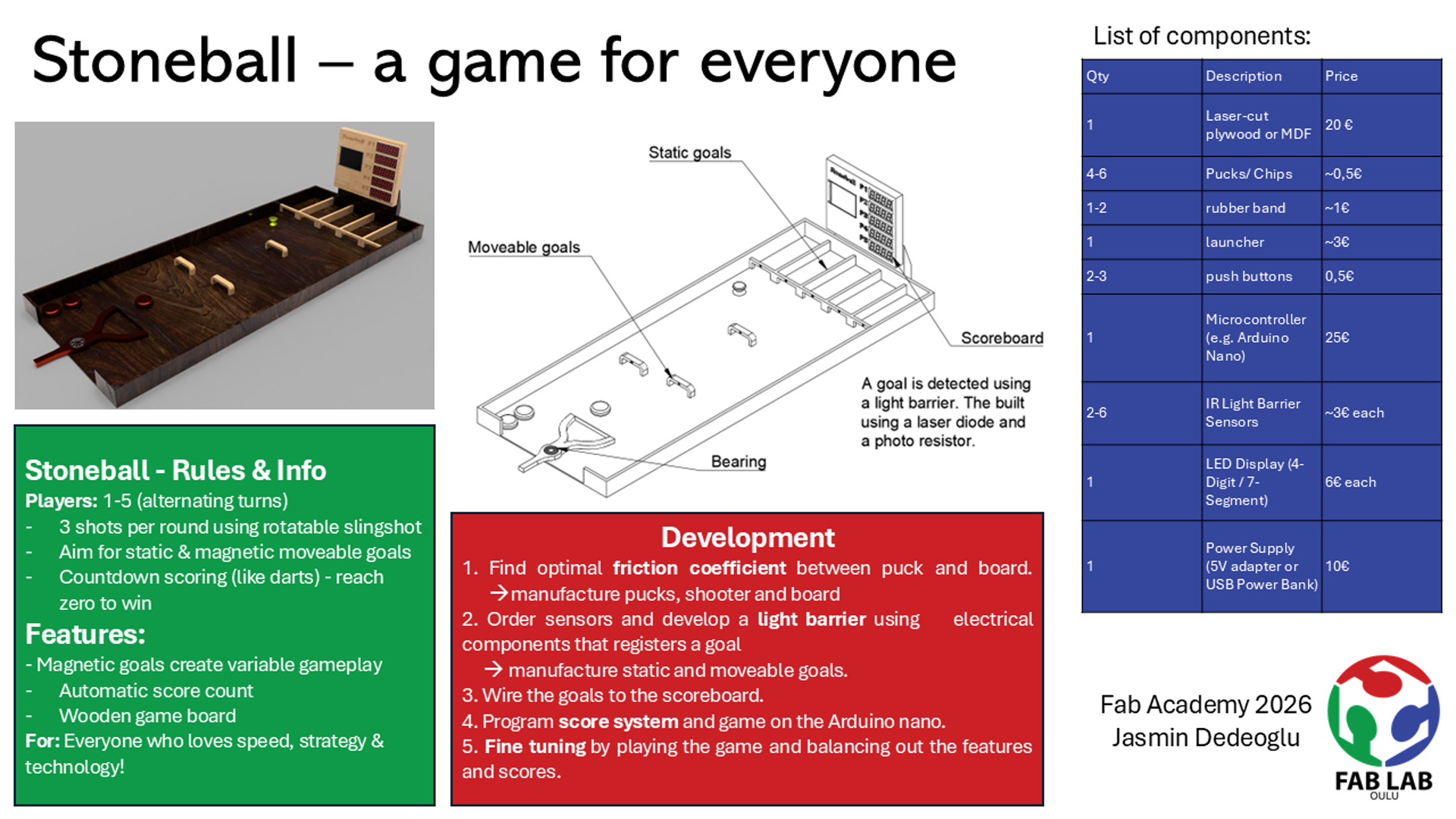
The project slide is going to be modified once the project is built: - picture of the finished project in the middle - less text - explain how the game works by pointing to the different elements and add a short text to it
Project video
The video is a placeholder. I first wrote a text and pasted it into a text-to-speech converter. I animated the video with the animation tool in Fusion 360. Last but not least I fused the audio and animation video in DaVinci Resolve Studio.
In the end the video should include the manufacturing process of the final project.